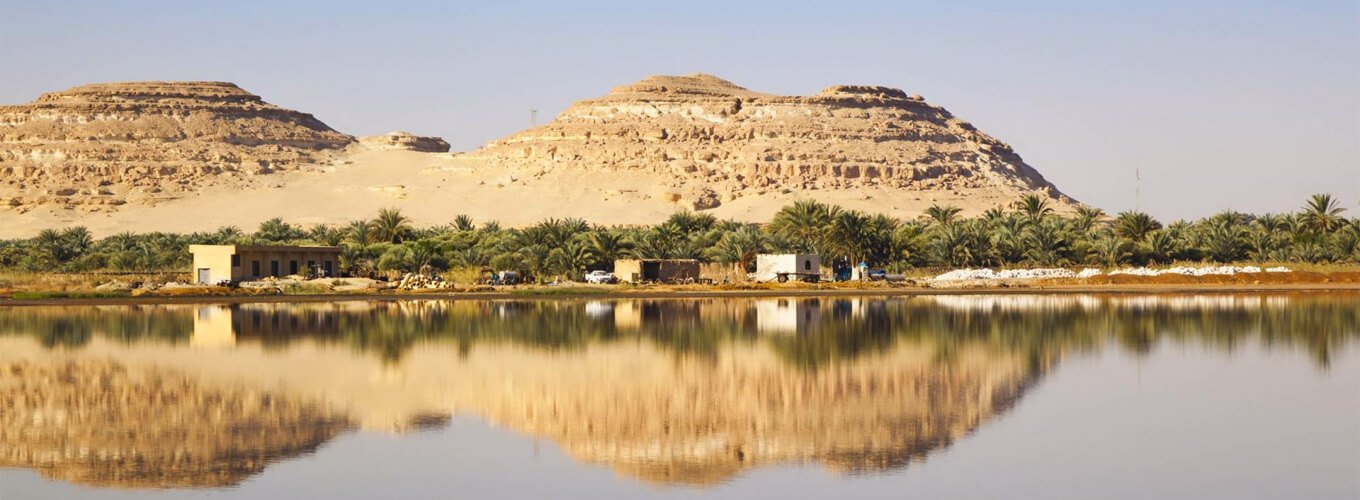
Siwa Oasis is a remote, palm-filled oasis in Egypt’s Western Desert near the Libyan border, famous for its Amazigh (Berber) culture, the ancient Oracle Temple linked to Alexander the Great, the mud-brick Shali fortress, salt lakes and desert springs. It is around 8 hours by road from Cairo.
Some destinations impress you; Siwa quietly rearranges how you think about the desert. Tucked deep in Egypt’s Western Desert, roughly 750 to 780 kilometres from Cairo, this green enclave feels genuinely remote, and that is precisely its magic. Neon-blue salt lakes sit beside crumbling mudbrick fortresses, date palms and olive groves rise from underground springs, and the nights are so dark that the stars feel close enough to touch. It stayed isolated for so long, a paved road only reached it in the 1980s, that time here still moves at its own unhurried pace.
This Siwa Oasis travel guide is designed to make the planning easy without draining the wonder. You will find advice on when to visit, how to survive the long journey, how to get around once you arrive, and which experiences, from effortless salt-lake floats to sunset climbs over the Great Sand Sea, deserve a place on your itinerary.
Siwa at a glance
The oasis centres on the ruined Shali fortress, whose salt-mudbrick walls still offer sweeping views from the top. Around it, a community of roughly 25,000 to 33,000 people keeps the Amazigh (Siwi) language and customs alive, giving the place a culture distinct from anywhere else in Egypt. The central salt lake and mineral-rich springs, including the famous Cleopatra’s Spring, give the water an almost otherworldly sheen.
Plan for at least three days and two nights. That gives you enough time to float in the lakes, rinse off at a spring, climb Shali for the views, and visit the Temple of the Oracle without rushing. Base yourself in town for cafés and easy access, or choose a quieter edge-of-oasis lodge for star-filled nights.

When to visit
The comfortable window runs from October to March. Daytime temperatures generally sit between 18 and 25°C, warm enough to explore without the heat sapping your energy, while nights turn crisp and clear, perfect for stargazing. Pack layers so you can move easily from the midday sun to chilly evenings.
Summer is a different proposition entirely. Temperatures often climb above 40°C, the air turns dry and dusty, and some seasonal businesses close for the hottest weeks. If you can only travel in summer, restrict climbs and walks to the early morning and late afternoon, and carry more water than you think you need. For most travellers, though, the autumn-to-spring stretch is the clear winner.
Getting there from Cairo
There is no way around it: reaching Siwa is a commitment. The journey crosses coastal roads and open desert and typically takes eight to twelve hours depending on road works, stops and checkpoints. Plan to arrive with daylight to spare, and keep your route saved offline.
Bus versus private car
Overnight buses let you rest while covering distance and are a straightforward way to split the trip via Alexandria or Marsa Matrouh, though comfort is basic and schedules vary. A private car or driver offers far more flexibility for breaks and pacing; just expect the same eight-to-twelve-hour range and slow right down at night for large potholes and thin services.
Breaking the journey
If a full day on the road sounds daunting, split it. Stopping overnight in Alexandria or Marsa Matrouh shortens the final leg and lets you arrive rested rather than frazzled.
Checkpoints
Military checkpoints become more frequent as you approach the Libyan border region. Expect polite passport checks and the occasional bag inspection, so keep your documents handy and your luggage organised. Fuel, snacks and restrooms appear only sporadically along the route, so top up whenever you can and carry your own supplies.
Getting around the oasis
Once you arrive, transport is refreshingly simple, if you match the vehicle to the terrain. Tuk-tuks are the easiest way to move around town and usually cost around 20 to 30 EGP per ride; they are plentiful and easy to flag down. For flat, quiet lanes between springs, cafés and viewpoints, renting a bicycle is often the most relaxed option, especially in the cool of the morning.
For the Great Sand Sea, however, you must use a proper 4×4 with an experienced driver who knows the safe routes and shifting sands, this is not the place to improvise. There are no ride-hailing apps locally, and mobile signal drops away outside the centre, so always confirm pick-up times and meeting points in advance. If you find a reliable driver, save the contact; it will make the rest of your trip run far more smoothly.
The best things to do in Siwa
Float in the salt lakes and rinse at the springs
Start with the hyper-saline lakes, where the sheer density of salt lets you lie back and float without effort. Wear water shoes, and skip the dip if you have any open cuts, as the salt stings. Afterwards, head to Cleopatra’s Spring to rinse off the minerals and cool down; expect basic freshwater showers for a small fee, so keep change handy.
Climb the Shali Fortress
Climb the old Shali fortress for a sweeping panorama over palms, water and mudbrick rooftops. Its karshif walls, built from salt-impregnated mud, tell the town’s long story even where rain has worn them down.
Explore the ancient tombs and temples
At the Mountain of the Dead you can see Ptolemaic and Roman-era tombs, including the beautifully decorated tomb of Si-Amun; follow the on-site photography rules and bring small cash for entry. Nearby, the Temple of the Oracle at Aghurmi is where Alexander the Great is said to have consulted the oracle, and a short walk away at Umm Ubayd a single carved wall still stands as a fragment of another temple.
Into the Great Sand Sea
West of the oasis, the Great Sand Sea unrolls in vast, smooth ridgelines, with dunes rising to around 140 metres. This is the setting for the classic Siwa desert safari: sandboarding down silky slopes, bouncing across the flats in a 4×4, and crossing fossil-scattered ground that hints at an ancient seabed.
Between runs, soak in a natural hot spring where the warm water takes the edge off the desert wind. The reward everyone comes for is the golden hour: pull up with tea and snacks and watch the sand glow amber and violet as the sun drops. Expect bumpy sections, so stow loose items and keep cameras secure, pack a light layer for the cooler evening air, and if you are new to boarding, start on the gentler dunes.
Sunsets and starry nights
Fatnas Island
As the light softens, Fatnas Island becomes the front-row seat for sunset over glassy water. There is usually no charge beyond buying a drink, so order a juice or tea, find a quiet spot, and watch the colours deepen as the lake mirrors the sky. Arrive early, as the best seats fill fast, and on a still evening you may catch a near-perfect reflection.
Gabal Dakrur
For a different vantage point, take the short trail up Gabal Dakrur. The climb takes only about twenty minutes and rewards you with wide 360-degree views over palms, rooftops and salt flats. Evenings cool quickly, so bring a light jacket, switch your phone to a red-light setting to protect your night vision, and carry a small flashlight for the walk back.
Culture and traditions
Siwa’s identity is built on its Amazigh roots. The Siwi language is still widely spoken in the markets and lanes, so learning a simple greeting goes a long way toward warmer exchanges. The architecture tells its own story: karshif, the salt-and-mud building material, gives the town its carved, weathered look, often finished with palm-frond details in doors and roofs. To understand daily life, visit the Siwa House Museum, where clothing, jewellery and tools connect the community to the land around it.
If your timing is lucky, the Siyaha festival, sometimes called the Festival of Forgiveness, unfolds over three days near the October full moon on Mount Dakrur. Centred on reconciliation, shared meals and communal songs, it is a rare window into living tradition. As always, dress modestly and ask before photographing people, especially in quieter corners; travellers who move slowly and observe tend to have the most meaningful encounters.

Eating and drinking
Siwa’s kitchen is shaped by what grows here: dates, olives and desert herbs. Expect warm flatbreads, olive-rich stews and date-forward sweets at small cafés and hotel tables. Try a glass of creamy date juice as a pick-me-up after a spring visit, and look out for geryaa, a local pasta dish often served with lamb. The more adventurous can sample a small portion of camel stew, whose subtle caramel notes surprise many first-timers.
Cafés cluster around the springs and the main square, where service is relaxed and prices modest. Menus shift with the season, so ask what is fresh that day; hotel kitchens tend to cook with local produce and are happy to explain their dishes. Keep small cash on hand, orders move faster and you can graze across more places.
Where to stay
In town
Most visitors choose a downtown hotel for easy walks to cafés and shops, quick transport for day trips, and close proximity to the Shali ruins. It is the most convenient base for daytime exploring.
Eco-lodges
For a more atmospheric stay, the eco-lodges lean into mudbrick walls, palm-frond details and candlelit evenings. Power is deliberately limited, so bring a headlamp and settle into quieter, more natural nights.
A desert night at Bir Wahed
Spending one night near Bir Wahed adds a rustic camp experience with springs close by. Nights are cool and still, so pack a warm layer for late dinners and early sunrise sessions. A single town base plus one desert night is the ideal balance for a short trip.
Practical tips
- Carry cash: ATMs are few and sometimes empty, so withdraw what you need before you arrive.
- Go offline-ready: download maps and key addresses, as signal fades fast once you leave the centre.
- Dress modestly: loose trousers, long sleeves and a scarf help with sun, dust and local custom.
- Ask before photographing people, especially in quieter neighbourhoods and at cultural events.
- Pack smart: sunscreen, sunglasses, a refillable bottle, a light jacket for the night, water shoes and a towel for lake and spring stops.
- Stay safe on the roads: expect long stretches without services, keep passports accessible at checkpoints, and only enter the dunes with an experienced driver on established tracks.
Suggested itineraries
The easiest way to plan is to think in blocks: mornings for springs and floats, afternoons for climbs and sunsets.
Two days: the highlights
Arrive, settle in, and float the salt lakes early while the water is calm. Rinse at Cleopatra’s Spring, then climb Shali Fortress in the late afternoon for warm light before dinner in town. Close the day with sunset at Fatnas Island. On day two, start at the Mountain of the Dead to see Si-Amun’s tomb art, then loop to the Temple of the Oracle and Umm Ubayd.
Three to four days: dunes and deeper history
Add a half-day tour into the Great Sand Sea for dunes, sandboarding and a hot-spring soak. Use the spare hours for the markets, the Siwa House Museum and extra viewpoints. If you can, split your stay, two nights in town and one near the dunes, so both sunrise and sunset are easy to catch.
Final thoughts
The best of Siwa comes down to a handful of unforgettable moments: floating weightless on bright salt water, standing atop Shali Fortress at golden hour, and watching the light melt across a dune in the Great Sand Sea. Keep your plan loose enough to linger, pack for both heat and cool nights, and let the oasis set the pace. Choose a few favourite things, sit long enough to watch a sunset unfold, and this remote corner of the desert will quietly become one of your most treasured trips in Egypt.