The ancient Egyptians built the pyramids using organised teams of skilled workers who quarried and moved huge limestone and granite blocks with ramps, sledges, levers and water to reduce friction. Careful planning, astronomy and a large, well-fed workforce, not slaves, made these monuments possible around 4,500 years ago.
How did a civilisation working with copper tools, rope, sledges and river boats manage to raise stone mountains that still leave modern engineers scratching their heads? The honest answer is that they did it through relentless organisation rather than lost magic. This guide walks you through the practical mechanics of pyramid construction on the Giza Plateau, roughly 4,500 years ago, when the Great Pyramid of Khufu climbed to nearly 481 feet and became the tallest human-made structure on Earth for millennia.
Rather than repeating old myths about slaves and aliens, we lean on what the archaeology actually shows: planned worker settlements, bakeries, quarry marks, boat logbooks and cutting-edge scans. By the end you will understand the build as a coordinated national project with distinct phases, real trade-offs and a few genuine mysteries that remain open.
How This Guide Approaches the Puzzle
Instead of treating pyramid-building as one giant unanswerable question, we break it into stages you can actually reason about. Each phase reflects a specific job that a skilled crew performed, in an order that kept the site moving.
A phase-by-phase framework
You will follow the stone from start to finish: sourcing it at the quarry, moving it overland and by river, hauling it up ramps, levering it into position and finishing the outer face. Seeing the work as a sequence makes it clear why timing and hand-offs between teams mattered as much as raw muscle.
Ramps, levers and evidence
Most Egyptologists now agree that ramps did the heavy lifting for the bulk of the structure, with levering taking over for the upper courses where a full-height ramp becomes impractical. Where possible we test ideas against physical clues, tool marks on quarry walls, the remains of small ramps and causeways, and modern experiments that measure how much effort a given gradient really demands. Treat any bold new theory the same way: does it fit the tool marks, the settlement evidence and the logistics?
Setting the Scene: The Old Kingdom Building Boom
Around 2550 BCE, Egypt’s rulers poured national resources into a programme of royal tombs on the Giza Plateau. These were not vanity projects alone; a pharaoh’s pyramid secured his passage into the afterlife and reinforced the cosmic order the state was built on.
From Khufu to Menkaure
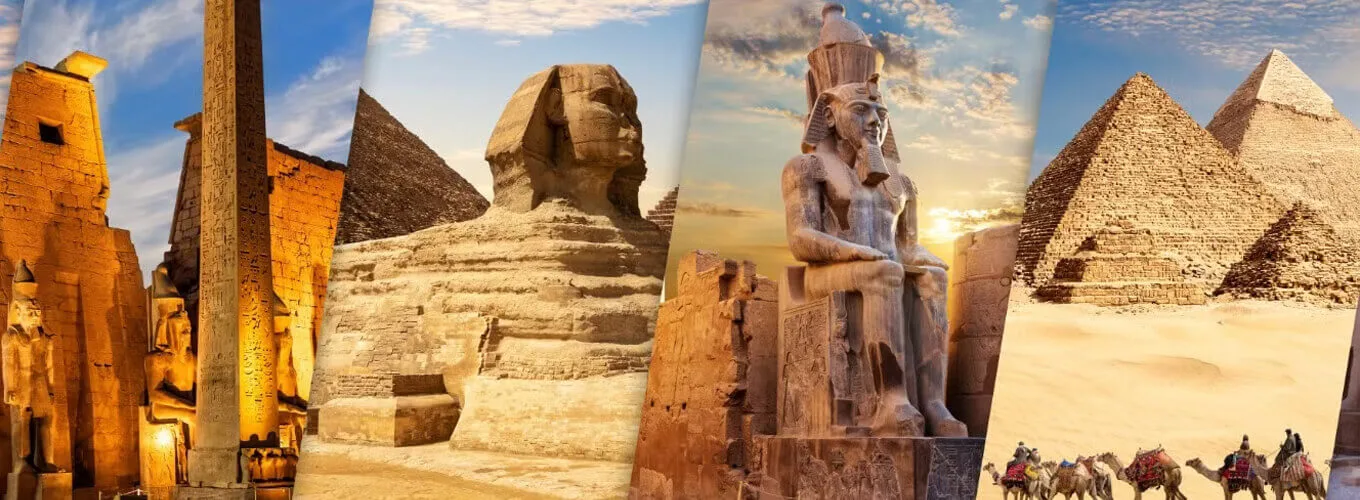
Khufu launched the largest of the three great monuments, a pyramid raised in carefully planned stages at the heart of a wider funerary complex. His successor Khafre added a comparable complex, famously associated with the Great Sphinx. Menkaure closed the sequence with a smaller pyramid, a pair of temples and three subsidiary queens’ pyramids.
The sheer scale
The Great Pyramid is estimated to contain around 2.3 million stone blocks and originally stood close to 481 feet tall. Numbers like these only make sense when you picture the supply chain behind them: years of quarrying, ferrying and placing stone, all synchronised with temple, causeway and support-structure work happening at the same time.
Fact Versus Speculation
A useful habit when reading about the pyramids is to separate what the evidence supports from what remains guesswork.
What the tool marks tell us
On softer limestone you can still see the crescent-shaped impressions left by copper chisels. On hard Aswan granite, workers relied on pounding with dolerite balls and grinding with sand abrasives. These marks are physical, repeatable evidence, and experiments recreating the same techniques back them up. That is a very different footing from a colourful story with no material trace.
Why the methods changed over time
Building techniques were not frozen. The earliest great pyramids used solid stone cores, but by the Middle Kingdom many builders switched to mud-brick cores dressed with a limestone skin, a sensible way to save labour and stone. That shift is a reminder that the Egyptians were pragmatic problem-solvers adapting to cost, speed and safety, not devotees of a single sacred recipe.
From Quarry to Site: Choosing the Right Stone
Every block began as living rock, and the Egyptians matched each material to the job it had to do.
Limestone, Tura casing and granite
Local limestone made up the bulk of the core courses. Finer, brighter Tura limestone from across the river formed the smooth outer casing that once made the pyramids gleam. Aswan granite, far harder and heavier, was reserved for high-stress points such as burial-chamber roofs and blocking portcullises.
Matching tools to rock
Softer blocks yielded to copper chisels, while harder stone demanded dolerite pounding and patient sand abrasion. The wear patterns on quarry faces even hint at maintenance routines, tools being resharpened and replaced so crews were never left idle.
Mortar and handling heavy elements
Gypsum-based mortar and rubble packing filled the gaps behind fine casing, stabilising the rougher geometry underneath. Some elements weighed many tonnes, so trimming and staging often happened close to the quarry as well as on site, all timed to keep hundreds of thousands of blocks flowing into place.
Moving Millions of Tonnes
Transport, not lifting, may have been the single biggest challenge. Getting stone from a distant quarry to the base of a rising pyramid required both clever physics and tight scheduling.
Sledges and the wet-sand trick
A famous tomb painting shows roughly 172 men dragging a colossal statue on a sledge while a figure pours liquid onto the sand ahead of the runners. That detail turns out to be sound engineering: modern experiments confirm that dampening packed sand dramatically cuts friction, so a smaller team can move a heavier load with steadier effort.
Rollers, cradles and crew size
For long, regular stones, cradle-style rollers can outperform flat sledge runners, while sledges remain the better bet for irregular blocks. A practical rule emerges: scale the crew to the weight class, small teams for two-to-three-tonne blocks, much larger teams for the heaviest lifts.
The river leg and Merer’s diary
One of the most exciting recent sources is the logbook of an official named Merer, which records boats ferrying Tura limestone to Giza. It confirms a genuine river stage in the supply chain and shows how tightly boat crews, shore teams, sledging lanes and ramp managers had to be coordinated to avoid bottlenecks.
A planning baseline
Field trials give useful rough figures: an 18-man crew has moved a 2.5-tonne block up a modest incline at around 18 metres per minute. Treat that as a planning yardstick for rest rotations, staging lanes and how often trackways needed re-wetting to stop them rutting.
Ramps in Practice
Ramps are central to almost every serious reconstruction, but the shape and scale are still debated.
Straight, zig-zag, spiral and internal designs
A single straight ramp reaching the summit would need an enormous footprint and colossal volumes of fill, and no such structure has been found. Zig-zag ramps against the pyramid’s flank save space and ease the gradient, while spiral or internal routes let crews stay close to the working face. Each design trades footprint against complexity.
The missing mega-ramp
Excavators do find berms, inclined causeways and short working ramps around Giza, but nothing on the scale a full-height single ramp would require. The evidence points firmly towards a family of smaller, staged solutions rather than one giant slope.
Combining ramps with levering
The most workable model uses ramps to bring stone up to staging platforms, then switches to levering for the topmost courses near the apex. Keeping ramp gradients gentle, in the region of 10 per cent, protects both traction and safety. Turnarounds, passing bays and reinforced edges kept traffic flowing and stopped the ramps from collapsing under load.
Levering and Final Placement
Once a block reached its course, it still had to be nudged into exactly the right spot without damaging finished surfaces.
Slow shimming versus quick single lifts
Experimental archaeology offers a spread of results. Incremental shimming, gradually rocking a block up on packing, has raised a course in roughly an hour and a half in one trial, while a refined pallet-and-block variant cut small lifts to a couple of minutes. A separate test of a single-lift lever device raised an 1,100 kg block in under a minute with a healthy safety margin. Which method suits a given block depends on its weight, the crew’s skill and the levers to hand.
Job-site routines
Practical crews standardised lever lengths and shim sizes, ran an inspection after each placement and set aside dedicated staging ledges so final lifts did not clog ramp entrances. Clear sequencing kept course lines square and made daily progress predictable, which is exactly what a decades-long project needs.
The Nile and the Lost Ahramat Branch
Water was the true highway of the ancient world, and new research has revealed just how close it once ran to the building sites.
A vanished river arm
A 2024 study mapped a now-extinct channel, dubbed the Ahramat Branch, roughly half a kilometre wide and at least 25 metres deep, that once flowed near many pyramid workfronts. It offered a direct route for heavily laden boats to reach quays close to the plateau, dramatically shortening the overland haul.
Boats, barges and a note of caution
Barge capacities had to be matched to multi-tonne loads and timed to stable water levels. Some researchers have floated the idea of locks or hydraulic lifts, but there is no clear on-site evidence for such systems, so that remains speculation. What is well supported is a linked network of the main river, the Ahramat Branch, temporary canals and embankments that turned a regional resource base into a dependable artery of supply.
Organising the Workforce
Behind the stone stood tens of thousands of people who had to be housed, fed and directed.
Skilled crews, not slaves
Excavations near the plateau uncovered a workers’ settlement covering around 17 acres, complete with bakeries and abundant animal bones, clear signs of a well-fed, organised labour force rather than the enslaved masses of popular imagination. Work was divided among rotating crews with defined roles: quarrying, hauling, ramp maintenance, levering and finishing, each under leaders responsible for safety, tool upkeep and quality.
The complex beyond the pyramid
Each royal project was far more than a single monument. Temples, causeways and boat pits surrounded the pyramids, and Khafre’s layout tied the Great Sphinx into the ritual and logistical landscape. Managing all of this meant synchronising stone deliveries with interior chamber work and keeping communication flowing from the waterfront to the ramps to the apex.
What Modern Science Adds
New imaging is quietly rewriting parts of the story without resorting to fantasy.
Cosmic-ray scans and hidden voids
Muography, which uses naturally occurring cosmic-ray particles to see through solid rock, has revealed large previously unknown voids inside the Great Pyramid, including one comparable in size to the Grand Gallery and a corridor behind the north face. Some specialists suggest such spaces relate to stress relief or served as temporary passages during construction, ideas that fit neatly with the logistics revealed by Merer’s diary and the Ahramat Branch.
Why debate is healthy
Scholars broadly accept ramps and levering as parts of one integrated system, while the notion of a single towering mega-ramp is widely rejected for lack of evidence. Comparing scans, material studies and experimental builds is exactly how the field narrows down what a skilled team most plausibly did, and honestly flags where the proof runs thin.
Conclusion
Strip away the myths and the pyramids emerge as one of history’s great feats of project management. Quarrying, river transport, sledging, ramps and levering formed a coherent workflow that moved staggering quantities of stone with accuracy and care over many years, all sustained by a well-organised, well-fed national workforce.
The Giza complexes wove temples, causeways, boat pits and the Great Sphinx around their central pyramids, and modern scans plus the mapping of the lost Ahramat Branch keep adding detail while leaving room for future discovery. The best mindset for any new claim about how the pyramids were built is the same one the Egyptians themselves would recognise: look for evidence, test whether it can be repeated, and check that it fits what we already know about the logistics on the ground.