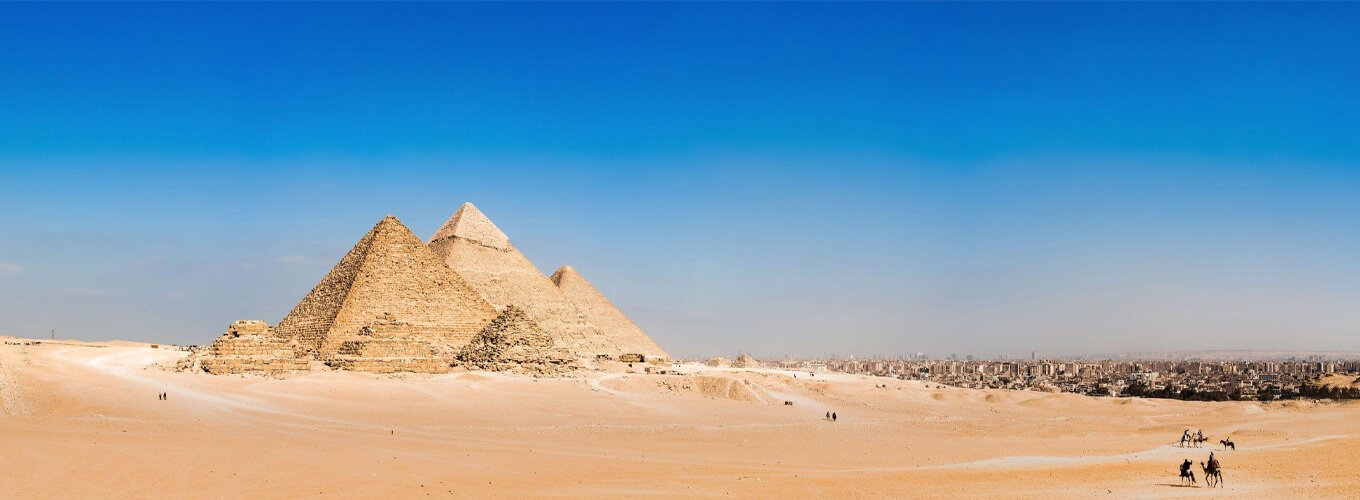
The Pyramids of Giza were built around 4,500 years ago during Egypt’s Old Kingdom as royal tombs for pharaohs Khufu, Khafre and Menkaure. The Great Pyramid of Khufu, once about 146 metres tall, is the largest and the only surviving wonder of the ancient world.
How can three heaps of shaped stone still hold our attention four thousand years after the last block was set? The pyramids of Giza remain the most recognisable structures on earth, and their story is far richer than the postcard image suggests. This account traces how three Fourth-Dynasty monuments on the west bank of the Nile came to define ideas about kingship, ritual, and engineering, and why they still shape the way we study the ancient world today.
Setting the scene: the plateau, the river, and a wonder of the world
The Giza plateau was no accident of location. Its hard limestone bedrock offered stable foundations and kept groundwater at bay, both essential when raising monuments of enormous weight. Rising just west of the Nile and within sight of the old capital at Memphis, the site tied royal power directly to the fertile floodplain while facing the setting sun, a direction long associated with rebirth in ancient Egypt.
From Memphis to the west bank
Each pyramid was only the centrepiece of a much larger complex. A valley temple stood near the river, linked by a long causeway to a mortuary temple on the escarpment, creating a ceremonial route that carried the dead king symbolically from the water to his tomb. Around these royal structures, grids of mastaba tombs housed relatives and officials, extending the king’s presence across the plateau.

Seven Wonders and World Heritage status
In antiquity the monuments earned a place among the Seven Wonders of the ancient world, and the Great Pyramid is the only one still standing. Today the whole plateau is protected within the wider Memphis-area listing that UNESCO inscribed in 1979, a designation that helps conserve not just the pyramids themselves but the cultural landscape around them.
Old Kingdom origins: Khufu, Khafre, and Menkaure
Three rulers of the Fourth Dynasty gave Giza its silhouette, and each set a different scale and tone for those who followed.
The Great Pyramid of Khufu
Khufu’s monument still defines technical ambition. Its base averages roughly 230 metres on each side and it rose to an original height of about 147 metres, with faces set at an angle close to 51 degrees and aligned with striking accuracy to the cardinal points. The structure contains an estimated 2.3 million blocks weighing something in the region of 5.75 million tonnes. Nearby finds, such as the empty sarcophagus of Queen Hetepheres, add further royal context to the site.
Khafre’s pyramid and the Great Sphinx
Khafre, Khufu’s son, built a slightly smaller pyramid on higher bedrock, so that it often appears the taller of the two from a distance. Carved from the living limestone beside his valley temple, the Great Sphinx reads as a guardian for the whole complex, its human head set on a lion’s body.
Menkaure and the turn towards smaller tombs
Menkaure’s pyramid is markedly smaller, standing around 66 metres high. That reduction hints at shifting resources, politics, or priorities within the dynasty. Taken together, however, the three pyramids form a single planned landscape of mortuary temples, causeways, queens’ pyramids, and mastabas that knit royal memory across generations.
How the pyramids were built
The construction of Giza is best understood as a problem of materials, manpower, and method, solved with remarkable discipline.
Limestone, granite, and precise joints
The core was built from yellowish limestone quarried close by, while a finer, lighter limestone formed the outer casing that once made the monuments gleam. Granite, hauled from far to the south, was reserved for the King’s Chamber and the relieving chambers above it, where loads concentrated. The precision of the casing joints sets these works apart from most other Egyptian masonry and helped achieve their sharp angles and smooth faces.
Ramps, sledges, and simple machines
Most scholars favour some combination of sloping and encircling earthen ramps as the primary means of lifting blocks. Workers dragged the stones on sledges, using rollers, wooden levers, and carefully staged sequences, and likely wetted the sand ahead of the sledges to cut friction, a technique depicted in ancient scenes.
Numbers and workforce
The headline figures, roughly 2.3 million blocks and around 5.75 million tonnes, reveal the true challenge: not just lifting stone, but organising quarries, roads, and daily deliveries. The historian Herodotus later claimed 100,000 labourers toiled for 20 years, yet the archaeological evidence points instead to a skilled permanent workforce closer to 20,000, supported by bakers, physicians, and supply crews who kept the project moving year-round.
Planning and accuracy
Builders worked course by course in a modular fashion. The consistent slope angles and near-perfect orientation to the cardinal points reveal careful surveying long before modern instruments. In short, intelligent material choices, disciplined planning, and simple machines allowed ancient teams to achieve an accuracy that still astonishes engineers today.
Inside the monuments
Step within and you find a world where ritual and engineering meet, narrow passages opening onto grand spaces that guided the king’s journey from earth to sky.
Corridors, the Queen’s Chamber, and the Grand Gallery
The original north entrance sits about 18 metres above the ground and leads down a descending corridor to a rough, unfinished chamber cut into the bedrock. An ascending passage then climbs towards the misnamed Queen’s Chamber and the soaring Grand Gallery, a corbelled hall some 46 metres long that frames both movement and sight.
The King’s Chamber and its shafts
A narrow passage opens into the King’s Chamber, lined and roofed entirely in granite. Above it sit five relieving chambers that redistribute the enormous weight of the masonry overhead. Two slender shafts run obliquely from the chamber towards the exterior; scholars still debate whether they served as spiritual pathways, star alignments, or simple ventilation, a reminder that ritual purpose and structural need were rarely separate.
Temples, causeways, and the afterlife
Each pyramid connected a mortuary temple on the plateau to a valley temple near the Nile by way of a long causeway. These temples anchored the rituals and offerings believed to sustain the king in the afterlife, while nearby mastabas and subsidiary pyramids for queens, officials, and kin formed a supporting neighbourhood that extended royal authority across a single coordinated complex.
A concise timeline
Early experiments and breakthrough forms
Around 2670 BC, Djoser’s stepped tomb at Saqqara began a new architectural path. By roughly 2630 BC, Snefru’s Red Pyramid at Dahshur proved that a true smooth-sided pyramid could stand, clearing the way for Giza to be built at full scale.
Khufu to Menkaure
Between about 2560 and 2510 BC, Khufu, Khafre, and Menkaure raised their complexes in a remarkably tight cluster, setting standards in size, layout, and ritual that later builders rarely matched.
Visitors, tunnels, and early exploration
Herodotus visited around 480 BC, and Roman travellers followed for centuries. In 820 AD the caliph al-Ma’mun forced a tunnel into the Great Pyramid, changing access to its interior for good.
Modern milestones
Davison identified a chamber above the King’s Chamber in 1765. Napoleon’s expedition and the Battle of the Pyramids in 1798, followed by Belzoni’s work in 1817 to 1818 and Vyse’s discoveries in 1837, opened the era of systematic study. The twentieth century added the equipment of Queen Hetepheres in 1925 and two dismantled boat pits found in 1954, while excavations in the 1980s and 1990s uncovered the workers’ districts. The Solar Boat Museum opened in 1985, and a 2021 site upgrade improved display and access. Across the years, study has steadily moved the questions from myth towards evidence.

The end of an era: the Fifth and Sixth Dynasties
Late in the Old Kingdom, both the scale of the monuments and the decoration inside them changed. Written spells began to reshape how the royal afterlife was recorded, just as the great building programmes grew simpler.
Pyramid texts and shifting power
Beginning with Unas in the Fifth Dynasty, artisans inscribed spells and hymns on interior walls. These Pyramid Texts, the oldest known body of religious writing, mark a shift from purely architectural grandeur to scripted ritual, and they reframe how we read a dead pharaoh’s journey.
Pepy II and the First Intermediate Period
Pepy II is said to have reigned for an extraordinary 94 years, yet his tomb at Saqqara rises only around 52 metres, a fraction of the earlier giants. That reduced scale signals shrinking resources and a changed idea of how kings projected power. After his long reign, central authority fragmented and monumental royal projects largely ceased during the First Intermediate Period. The Middle Kingdom later revived pyramid building, but never again at the scale of Giza.
Archaeology and what the ground reveals
Digging around the tombs uncovers the human story behind the stone: tools, food, and homes as telling as any statue.
Queen Hetepheres and elite life
In 1925 archaeologists found furniture, jewellery, and an empty sarcophagus near Khufu’s causeway. The cache reveals both the refinement of court craftsmanship and the careful rituals surrounding a royal burial.
Worker villages and workshops
The excavations of the 1980s and 1990s revealed bakeries, storerooms, and workshops that prove organised teams of skilled workers lived on site for long periods. Mud sealings, small statuettes, and inscriptions on pottery and bone speak of pride and identity, not anonymous slavery, while nearby worker tombs map the social layers around the labour zones.
Khufu’s solar boats
The two boat pits found in 1954, and the museum built to house one of the reconstructed vessels in 1985, preserve full ships that linked the temples, the pyramid complex, and the cult of the sun. Together, the stone tools, food remains, and sealings sketch a whole supply chain, and ongoing fieldwork keeps reshaping what we know.
The pyramids today
Compare the original profiles with what stands now and the changes are both striking and instructive.
Lost casing and visible crowns
The gleaming white limestone casing was largely stripped away in antiquity and the medieval period for use in other buildings. That loss altered each silhouette and lowered the Great Pyramid from around 147 metres to roughly 138 metres today. Khafre’s pyramid still keeps a cap of casing near its apex, offering a rare glimpse of how the finished monuments once looked.
The Sphinx and ongoing threats
The Great Sphinx measures about 73 metres long and 20 metres high, and it faces salt crystallisation, shifting groundwater, wind erosion, and pollution, problems that mirror the wider conservation needs of the plateau. Millions of visitors still come each year, and conservation teams work to balance access with protection through careful measurement, stabilisation, and controlled restoration.
Conclusion
Look back over the whole story and you see how engineering, belief, and human labour combined to create a royal landscape that has outlasted empires. The Great Pyramid still displays unmatched scale and precision, while Khafre and Menkaure carved a family line in stone. Follow the corridors to the King’s Chamber, weigh the evidence for a skilled workforce of around 20,000, and study the temples, causeways, mastabas, and solar boats, and the pyramids stop being mute monuments. Even stripped of their casing and much of their treasure, they remain one of humanity’s clearest lessons in how a place can hold memory across time.