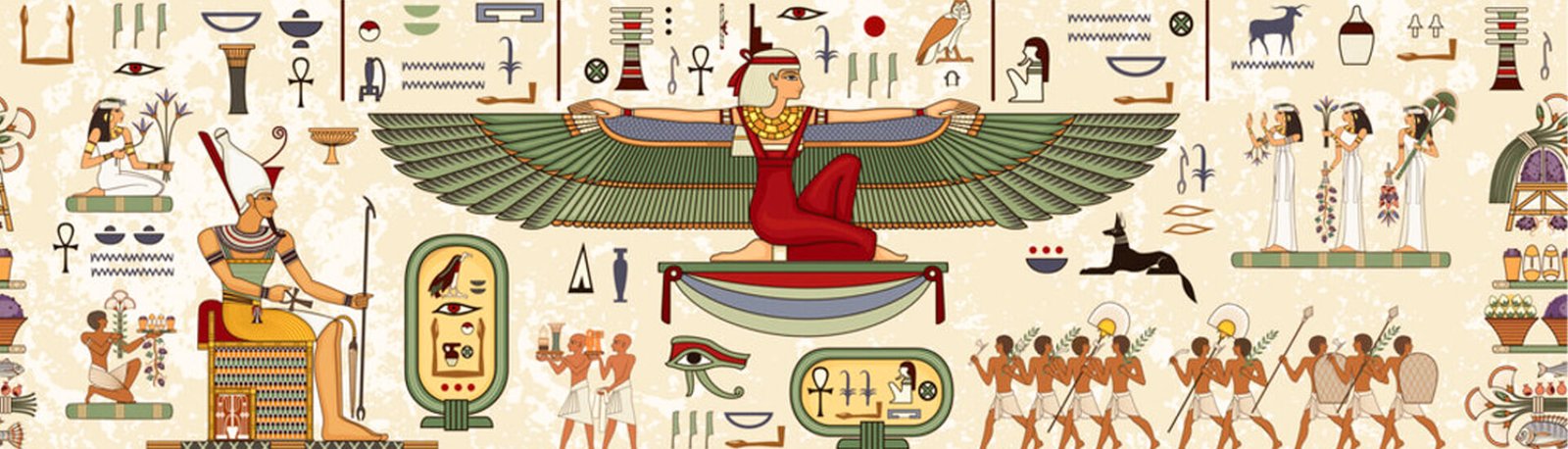
Ancient Egyptian symbols carried deep religious and protective meaning. The most famous include the ankh (life), the Eye of Horus (protection and health), the scarab (rebirth), the djed pillar (stability), the lotus (creation) and the was sceptre (power), all found across temples, tombs and jewellery.
In ancient Egypt, symbolism was woven into every layer of life, from grand royal ceremonies to the quiet hopes people carried into the afterlife. Far more than decoration, each symbol was a compact statement of belief, linking the visible world to the divine and the cosmic order the Egyptians called Ma’at. Carved into temple walls, painted in tombs and worn as amulets, these images offered protection, guidance and a promise of eternity.
From the Ankh’s promise of life to the watchful Eye of Horus, Egyptian symbols formed a visual language that bound gods, kings and ordinary people together. This guide explores the most famous ancient Egyptian symbols, what they meant, and why they still captivate travellers and history lovers today.
The great symbols of life, protection and power
The Ankh
Often called the “key of life”, the Ankh (a looped cross) is perhaps the most instantly recognisable Egyptian symbol. It represented life itself, both earthly and eternal, and gods are frequently shown holding it to the nose of a pharaoh, offering the breath of life. Some read its loop as a union of opposites, masculine and feminine, earth and sky. It appears throughout tomb art and funerary objects, and endures today in jewellery and design as a sign of life and spiritual balance.
The Djed pillar
A column crossed by four horizontal bars near its top, the Djed stood for stability, strength and endurance. Associated with Osiris, god of the afterlife, it was understood as his backbone and the resilience of life beyond death. The ceremonial “Raising of the Djed” symbolised the restoration of order and resurrection, and the symbol still speaks to the value of a solid foundation.
The Was sceptre
A tall staff with a forked base and a stylised animal head, the Was sceptre embodied power, dominion and divine authority. Held by gods and pharaohs, it signified their command over the natural and supernatural worlds and their duty to uphold cosmic order. It was also regarded as a magical instrument for warding off evil.
The scarab beetle
Modelled on the dung beetle and linked to Khepri, god of the rising sun, the scarab symbolised transformation, renewal and creation. Just as the beetle rolls its ball across the ground, so the sun was rolled across the sky each day. Scarab amulets were hugely popular as protective talismans, and the symbol came to stand for growth, perseverance and the eternal cycle of life.
The Tyet (knot of Isis)
Resembling an Ankh with downward-curving arms, the Tyet is tied to Isis, goddess of magic and motherhood, and represents protection, healing and feminine power. Often carved from red stone or glass to evoke the “blood of Isis”, it was placed with the deceased to guard them in the afterlife.
The crook and flail
Crossed over the chest of royal statues, the crook and flail were emblems of kingship. The shepherd’s crook expressed the pharaoh’s role as protector and guide of his people, while the flail represented the discipline and authority needed to maintain order.
The Shen ring
A loop of rope drawn into a circle with a horizontal base, the Shen symbolised eternity and protection, its unbroken shape suggesting completeness and infinity. Gods such as Horus and Ra are shown holding it, extending its protective power to the king.
The all-seeing eyes
The Eye of Horus (Wedjat)
A stylised human eye marked with falcon-like lines, the Eye of Horus stood for protection, health and restoration. In myth Horus lost his eye in battle and had it healed, so the symbol came to mean wholeness and recovery, and it was widely worn as a protective amulet.
The Eye of Ra
Visually similar but bound to the sun and often shown as fiery, the Eye of Ra expressed power, protection and, at times, destruction. It represented the sun god’s fierce defensive force and was personified by goddesses such as Sekhmet and Hathor.
Creation, the soul and the afterlife
The lotus (Sesen)
The lotus opens at sunrise and closes at dusk, so it naturally came to symbolise rebirth, creation and purity, rising clean from the muddy waters of the Nile. It features throughout creation myths and afterlife imagery, and is linked to deities such as Nefertum and Hathor.
The Ben-Ben
A pyramidal stone, the Ben-Ben represented the primeval mound from which creation first emerged, associated with the sun god Ra. Its form is thought to have inspired the shape of pyramids and the gilded tips of obelisks, which served as focal points for the sun’s light.
The Ka
Depicted as two upraised arms, the Ka was a person’s life force or spiritual double, believed to live on after death. Sustaining the Ka with offerings was central to Egyptian funerary practice.
The Ba
Shown as a bird with a human head, the Ba embodied an individual’s personality and soul, able to move between the living world and the afterlife. To achieve eternal life, the Ba had to reunite with the Ka.
The Feather of Ma’at
A simple ostrich feather, the emblem of the goddess Ma’at, represented truth, justice and cosmic balance. In the famous “Weighing of the Heart”, the deceased’s heart was balanced against this feather to judge their worthiness for the afterlife.
Crowns and emblems of kingship
Deshret, Hedjet and Pschent
The red Deshret crown signified rule over Lower Egypt and the fertile Nile Delta, while the tall white Hedjet crown represented Upper Egypt and its valleys. Combined, they formed the Pschent, the double crown that proclaimed the pharaoh’s rule over a unified Egypt and the duality of its two lands.
The Blue Crown (Khepresh)
A rounded blue crown, often studded with golden discs, the Khepresh was worn by pharaohs during military campaigns and ceremonies, emphasising their role as warriors and their divine support in conflict.
The Nemes headdress
The striped cloth headdress that drapes over the shoulders, familiar from the mask of Tutankhamun, marked royal status and connection to the gods, its ordered stripes echoing the pharaoh’s duty to uphold Ma’at.
The Uraeus
A rearing cobra worn at the brow of a crown, the Uraeus represented the goddess Wadjet, protector of Lower Egypt, and stood for royalty, divine authority and the power to strike down enemies.
Cosmos, eternity and rebirth
The Seba (star)
Shown as a five-pointed star, the Seba connected the heavens to ideas of guidance, learning and divine knowledge. It appears in temple inscriptions and astronomical texts, symbolising the stars as eternal guides.
The Ajet (horizon) and Amenta
The Ajet depicts the sun rising between two peaks, a symbol of renewal and the daily cycle of life tied to Ra. Amenta, by contrast, marked the west where the sun sets, representing the land of the dead and the realm of Osiris.
The winged sun disc
A golden disc flanked by outstretched wings and sometimes cobras, this symbol combined the power of the sun god Ra with divine protection, and was often placed above temple entrances to guard sacred space.
The Ouroboros
A serpent swallowing its own tail to form a circle, the Ouroboros expressed eternity, cyclical time and the unity of all things. It first appeared in ancient Egypt as an image of the endless cycle of the cosmos.
The Bennu bird
A heron-like bird often compared to the phoenix, the Bennu symbolised rebirth, creation and eternal life. Linked to Ra and the Ben-Ben stone, it was said to have played a part in the world’s creation.
The crescent
The crescent moon carried associations of femininity, motherhood and fertility, connected to Isis and other lunar deities, and reflected the nurturing rhythms of nature.
Symbols of ritual and daily life
Canopic jars
Used in mummification, these four jars each bore the head of one of the Four Sons of Horus and protected a specific organ: Imsety (human head) the liver, Hapi (baboon) the lungs, Duamutef (jackal) the stomach and Qebehsenuef (falcon) the intestines. They were essential to preparing the body for resurrection.
The Menat necklace
A beaded necklace with a counterweight, associated with Hathor, the Menat symbolised fertility, joy, music and divine favour, and featured in temple rituals.
The sistrum
A handheld rattle with a looped frame and movable rods, the sistrum was linked to Hathor and played during ceremonies to invoke blessings and ward off evil with sacred sound.
The cartouche (Shenu)
An oval enclosing hieroglyphs, the cartouche encircled a pharaoh’s name to signal divine authority and protection, ensuring the royal name endured for eternity. It remains a popular design for personalised jewellery today.
The Tree of Life and the obelisk
The Tree of Life represented creation, sustenance and the connection between heaven, earth and the underworld, linked to gods such as Hathor and Osiris. The obelisk, a tall four-sided pillar tapering to a gilded point, honoured the sun god Ra as a ray of sunlight rendered in stone, standing at the entrances of great temple complexes.
Quick reference: symbols and their meanings
| Symbol | Meaning |
|---|---|
| Ankh | Life, immortality and divine energy |
| Eye of Horus | Protection, health and restoration |
| Eye of Ra | Solar power, protection and divine wrath |
| Scarab | Transformation, rebirth and good fortune |
| Djed pillar | Stability, strength and endurance |
| Was sceptre | Power, dominion and divine authority |
| Tyet | Feminine power, healing and protection |
| Ka | Life force and spiritual double |
| Ba | The soul, moving between worlds |
| Feather of Ma’at | Truth, justice and cosmic balance |
| Shen | Eternity and protection |
| Uraeus | Royalty and divine authority |
| Winged sun | Solar power and eternal protection |
| Lotus (Sesen) | Rebirth, creation and purity |
| Pschent | The unity of Upper and Lower Egypt |
Why these symbols still matter
The symbols of ancient Egypt were never idle ornament. Each condensed a belief about life, death, protection or divine order into a single image that could be carved, worn or offered. Standing before them in the temples of Luxor, the tombs of the Valley of the Kings or the galleries of Cairo’s museums, you are reading a language thousands of years old, still legible in its hopes and fears. That enduring power is exactly why exploring these symbols in person, on a well-planned journey through Egypt, remains one of the most rewarding ways to connect with the ancient world.